
A Framework for In-Game Adjustments
Playing the Board in Front of You


The National Anthem
Before every game, during the national anthem, I close my eyes.
The scouting report is finished. The film has been watched. The matchups have been assigned. Whatever preparation could be done has already been done. There is nothing left to add to the game plan in those final two minutes before tip-off.
And yet, that’s usually when I start thinking about chaos.
Not in a nervous way. Not in a pessimistic way. More like a thought experiment.
What if their point guard is hurting us in a way we didn’t anticipate? What if the role player we barely talked about becomes the most important player on the floor? What if they put in a whole in offense designed to counter our coverage? What if foul trouble forces us into lineups we haven’t used all season?
I don’t think about these possibilities because I lack confidence in our preparation. In many ways, it’s the opposite. Preparation is what gives those questions value. The better you prepare, the more clearly you understand what you’re expecting to happen. You know the strengths you’re trying to take away. You know the actions you’re trying to disrupt. You know the matchups you’re counting on.
But that’s also when you become aware of something else.
The game doesn’t always cooperate.
A coach can spend hours studying film, identifying tendencies, building a scout, and constructing a plan that makes perfect sense on a whiteboard. Then the ball goes up, and within a few possessions the game starts moving in a direction that nobody predicted. Sometimes it’s subtle. Sometimes it’s obvious. Sometimes the problem announces itself immediately. Other times it takes an entire half before you realize the game you’re watching isn’t the game you prepared for.
The longer I’ve coached, the more I’ve become fascinated by those moments.
Not because they invalidate preparation. If anything, I think coaches often underestimate how much preparation matters. Most games are won before adjustments ever become necessary. Your identity matters. Your habits matter. Your gameplan matters.
But eventually every coach encounters the same challenge. The game presents a problem that the original plan isn’t solving.
And that’s where I’ve started to think we misunderstand in-game adjustments.
Most coaches talk about adjustments as if they’re answers. Switch the coverage. Change the matchup. Trap the ball screen. Double the post.
But I’ve become convinced that adjustments are rarely the difficult part. The difficult part is identifying the problem in the first place.
Because a bad diagnosis almost always leads to a bad adjustment.
A team makes eight threes, and we decide we need to run shooters off the line. A star player scores 25 points, and we decide we need to double-team him. We’re losing the rebounding battle, and we decide we need to play bigger.
Sometimes those are the right answers.
Sometimes they’re reactions to outcomes, not breakdowns in processes.
And I think that’s an important distinction.
The best coaches don’t seem to react to what is happening. They seem to react to why it is happening.
That difference may sound small, but I think it sits at the heart of game management.
Because before a coach can make an adjustment, he has to answer a much more difficult question: What process, not problem, am I actually trying to solve?
The Wrong Problem
One of the easiest mistakes to make during a game is confusing outcomes with processes.
The distinction sounds obvious when you say it out loud, but I think it’s responsible for a surprising number of poor in-game decisions. Coaches spend most of the game looking at outcomes. The scoreboard is an outcome. Shooting percentages are outcomes. Rebounding margins are outcomes. Turnovers, points in the paint, fast-break points, and three-point attempts are all outcomes. They’re the most visible pieces of information available to us, which makes them incredibly useful. It also makes them dangerous.
A team makes 10 three-pointers in the first half.
Most coaches immediately recognize that as a problem. And maybe it is. The question is whether the made threes are the thing we should actually be trying to solve.
But outcomes are often poor starting points for adjustments. They tell us what happened, but they rarely tell us why it happened. And if we don’t understand why something is happening, we run the risk of creating an adjustment that treats the symptom while leaving the underlying process untouched.
Take those 10 threes.
At halftime, a coach might decide that his team needs to do a better job running shooters off the line. On the surface, that sounds reasonable. The opponent is making threes, so we need to take away threes.
But where are those shots coming from?
Are they being created by a point guard repeatedly collapsing the defense and generating kick-outs? Are they the result of post kick outs or double teams? Are they coming from a stagger screen that we’re struggling to navigate? Are they even good shots, or is a poor shooter simply having an unusually good night?
Those are very different questions. Very different processes.
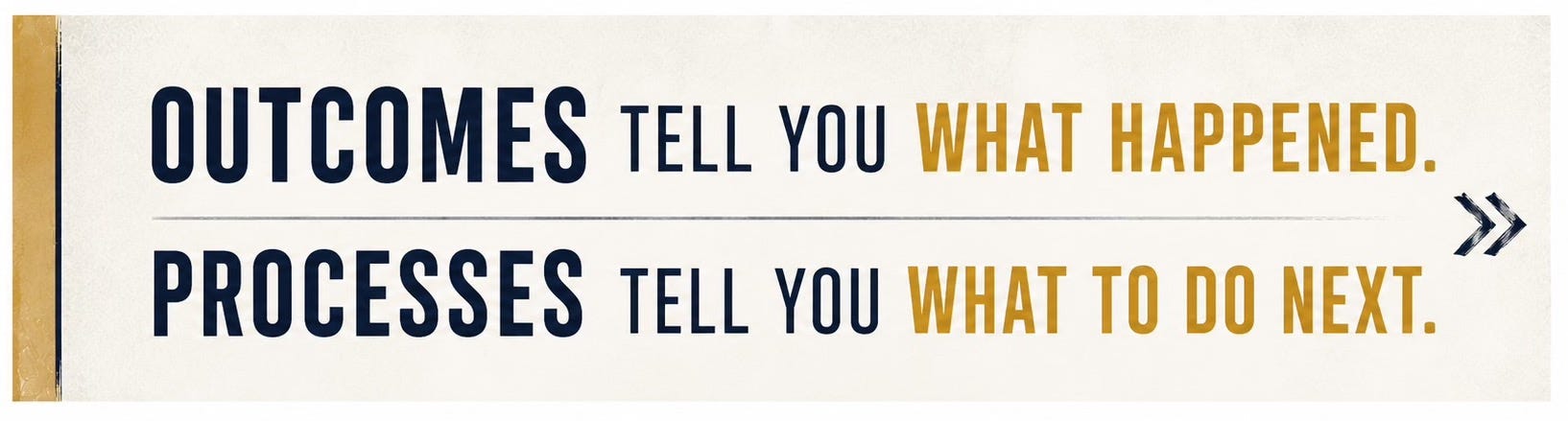
And because they’re different processes, they require different solutions.
If we just run shooters off the line, we might be turning one problem into 3 more.
The same thing happens when a star player scores 25 points.
A coach sees the number and starts thinking about traps, doubles, and matchup changes. But 25 points is not an explanation. It’s a result. One player can score 25 points in five completely different ways. He might be living at the free-throw line. He might be dominating in ball screens. He might be scoring in transition. He might be benefiting from offensive rebounds.
Those situations do not demand the same adjustment.
What makes this difficult is that outcomes naturally pull our attention toward them. Human beings are drawn to what is visible. And in many ways, coaching during a game is an attentional challenge. Hundreds of events occur every few possessions. Most of them are irrelevant. A few are incredibly important. The challenge is separating the two.
That’s why I’ve become increasingly skeptical of adjustment conversations that begin with solutions.
“We need to switch more.” “We need to trap.” “We need to run them off the line.”
Maybe.
But before we decide what to do, we should probably understand what we’re responding to.
Because the best coaches don’t seem obsessed with answers. They’re obsessed with questions and processes. They spend less time reacting to outcomes and more time tracing those outcomes back to the break downs that created them.
And once the process becomes clear, the adjustment often becomes obvious.
The challenge isn’t finding a solution. The challenge is identifying what is actually producing the result you’re trying to change.

Learning to Win
Another reason I’ve become increasingly interested in game management is that I’ve started to view winning differently than I did earlier in my coaching career.
Like many coaches, I spent my early years working primarily with younger players. In those environments, development was always the priority. The goal wasn’t simply to win games. It was to help players become better players. We wanted them to improve their skills, develop good habits, understand the game, and prepare themselves for the next level.
I still believe that.
In fact, I think youth sports often become problematic when winning completely overshadows development. Coaches discover shortcuts that produce immediate results but create long-term limitations. Players learn how to win a particular game instead of learning how to play the game well.
But I’ve also become less comfortable with the opposite extreme.
Sometimes coaches talk about development and winning as though they are competing priorities. The implication is that focusing on winning somehow comes at the expense of development, while focusing on development requires us to care less about winning.
The longer I’ve coached, the less useful that distinction has become.
I think it’s more accurate to view development and winning as points on the same spectrum rather than opposing philosophies.
At younger levels, development should dominate. At older levels, winning becomes increasingly important. During playoff basketball, it becomes the primary concern. The balance shifts depending on the environment, the age of the players, and the goals of the program.
What doesn’t change is that winning itself requires skills that must be developed.
Adaptability is a skill.
Competitiveness is a skill.
These aren’t abilities that suddenly appear when players reach varsity basketball or college basketball. They develop over time through experience.
Which is one reason I’ve become increasingly skeptical of the idea that coaches should completely separate development from winning. But for a long time, I didn’t think much about that distinction because most of my coaching energy was focused on helping players improve.
But the further I’ve moved toward the winning side of that spectrum, the more I’ve become interested in a different question: What actually separates teams that consistently find ways to win?
Talent obviously matters. Execution matters. But when two teams are relatively equal—or when you’re facing a team that may even be slightly better than you—those things are rarely enough by themselves.
Very few games are won simply because a coach stubbornly continued doing exactly what he planned to do beforehand.
The game changes.
A player gets hot. A coverage starts breaking down. A role player becomes more impactful than expected. Foul trouble alters the rotation. The game begins moving in a direction nobody anticipated.
And somewhere in that process, a coach and his players are forced to make a decision.
Do we continue doing what has always worked for us? Or do we adapt to what this particular game requires?
I think that’s one of the most overlooked skills in coaching, and even in playing.
Not the ability to build and hone a system. Not the ability to install and master a coverage. The ability to recognize when the game is demanding something different.
Because at some point, winning stops being about executing your plan or system.
It becomes about recognizing when your plan is no longer solving the problem in front of you.
Where Should We Look First?
Once I started thinking about game management this way, another question emerged.
If outcomes are often symptoms, and if successful adjustments depend on identifying the process creating those outcomes, where should a coach actually look when something isn’t working?
At first glance, that seems like a straightforward question. A team is getting beat in a particular way, so you identify the weakness and make an adjustment. That’s how most coaching conversations about in-game management sound.
But in practice, I’ve found the process is rarely that clean.
A team gives up a string of baskets, and someone immediately suggests changing the coverage. A star player gets hot, and we start discussing traps and double teams. A role player makes a few shots, and suddenly we’re contemplating an entirely different defensive approach.
Sometimes those adjustments are necessary.
Often they aren’t. More specifically, we tend to jump toward scheme before we’ve ruled out simpler explanations.
When something is going wrong, I’ve found myself working through the same sequence of questions.
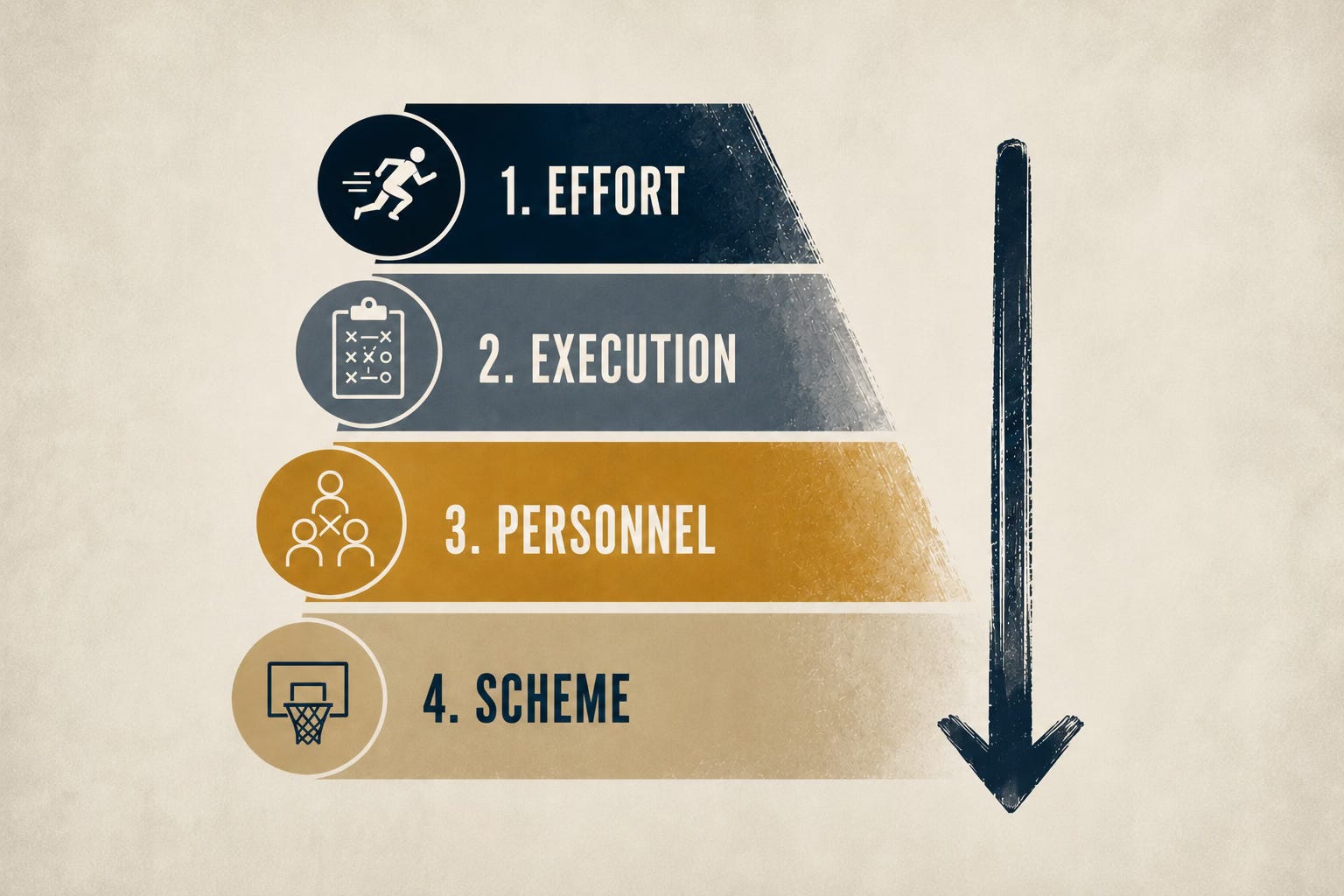
The first question is effort.
Not because effort solves every problem. It doesn’t. But basketball is still a game of physical and mental exertion. Players get tired. They lose focus. Urgency fluctuates. Sometimes the process creating the outcome is simply that one team is competing harder than the other.
The second question is execution.
This is where things become more interesting because execution is often mistaken for scheme.
A coach sees a breakdown and assumes the coverage isn’t working.
But is the coverage actually failing? Or is the coverage being executed poorly?
There’s a significant difference between those two things.
A late rotation doesn’t necessarily mean the rotation is wrong. A missed tag doesn’t necessarily mean the coverage is flawed. A shooter getting open doesn’t automatically mean the scheme needs to change. Sometimes the process creating the problem is simply that the players are not carrying out the plan as intended.
I’ve sat through plenty of halftimes where the temptation was to change everything, only to realize on film later that the original coverage would have worked perfectly if one or two details had been executed correctly.
Which raises another possibility.
Maybe the issue isn’t effort or execution.
Maybe it’s personnel.
This is probably the simplest adjustment in basketball.
Coaches often think of adjustments as changing what the team is doing. Sometimes the adjustment is changing who is doing it.
A different matchup. A different lineup. A player who is better equipped to handle a particular challenge. In many cases, those changes solve the problem without requiring any alteration to the scheme itself.
Only after working through those possibilities do I start thinking seriously about the scheme.
And that’s probably where my thinking has changed the most over time.
Earlier in my career, I was much quicker to look for schematic answers. If something wasn’t working, my instinct was often to ask what coverage we should switch to or when to go to our secondary defense,
Now I’m much more hesitant.
Not because schemes don’t matter. They absolutely do.
But because scheme is often the final answer, not the first one.
Which brings us back to the central challenge of game management. The adjustment itself is rarely the hard part. The hard part is understanding what actually needs to be adjusted.

Playing the Board in Front of You
The way we often talk about coaching can create the impression that every problem has a correct answer.
Identify the issue. Make the adjustment. Problem solved.
In reality, coaching rarely feels that clean.
Even after you’ve correctly identified the process creating the problem, there is usually another question waiting behind it: What am I willing to give up?
Most coaching decisions aren’t about finding perfect solutions. They’re about choosing which problems you would rather live with, in that moment, in that game.
A strange example where I’ve found myself thinking about this is Monopoly.
Like most people, I grew up playing it. And like most people, I spent years playing it poorly.
Then at some point I stumbled across articles about Monopoly strategy. People had studied the game. They knew which properties were most valuable. They understood probabilities. They could tell you which spaces were landed on most frequently and which strategies tended to produce the highest returns.
In other words, they had a plan.
And that’s useful.
But eventually the dice start rolling.
And once they do, the game begins developing its own personality.
The properties you wanted might be owned by someone else. The trades you expected never materialize. The board evolves in a way you didn’t anticipate. At some point, success depends less on the strategy you prepared and more on your ability to adapt to the board that’s actually in front of you.
Basketball feels remarkably similar.
Every coach enters a game with an identity. We spend months building systems because we believe those systems give us the best chance to succeed over time. We spend hours crafting scouts and gameplays to put our players in the best positions to succeed.
And most of the time, they do.
But eventually every game reaches a point where the board develops differently than expected. The point guard is creating more problems than anticipated. A shooter catches fire. A matchup isn’t working. Foul trouble changes the rotation. The game starts presenting choices. And every choice comes with a cost.
If you decide to trap the star player, you may create opportunities for role players.
If you stay home on shooters, you may allow the star to become more aggressive.
If you switch everything, you may create mismatches.
There is no adjustment that only creates benefits. Every adjustment solves one problem while introducing another. But the best game managers aren’t necessarily finding better solutions in isolation. They’re choosing better tradeoffs in those moments.
They’re identifying which problems are most dangerous and which problems they’re willing to tolerate in the short term.
That’s an important one distinction. Because more often, coaching resembles a series of negotiations with reality. You solve one issue and create another. You reduce one advantage and expose a different vulnerability. You continuously move resources from one place to another, banking on the new problem being more manageable than the old one.
Because the goal of game management isn’t to solve everything. It’s to eliminate problems.
And thus, the goal is to choose the problems that give your team the best chance to win.
Coaching the Game You’re Actually Playing
Mike Tyson famously said:
“Everybody has a plan until they get punched in the face.”
It’s one of those quotes that’s become so popular that it’s easy to dismiss.
But I appreciate what he’s actually describing. Not because planning doesn’t matter. Planning matters tremendously.
The goal isn’t to replace preparation with adaptation. The goal is to build preparation strong enough that adaptation becomes the exception rather than the rule.
But even the best plans eventually encounter reality.
The game starts asking a different question than the one you prepared for.
And at that point game management as less about a tactical skill, tt’s a perceptual skill.
The game is constantly presenting information. Some of it matters. Most of it doesn’t.
The coach’s job is to identify the few things that actually matter, understand the process creating them, and adapt before the game gets away from him.
That’s why the best adjustments often look obvious in hindsight.
The adjustment wasn’t the hard part. Seeing the game clearly was.
Every coach has a plan until the game changes. The best coaches recognize it first.
When you identify the issue as execution at what point do you say "we just aren't executing our scheme/coverage properly, we need to try something else" rather than continuously pushing for better execution. I often find myself thinking "well if we would just do it right, then it would work." But there has to be a point in the game where you decide they just aren't going to magically start executing and you try something else. Thoughts?